
Understanding Ozone Concentration Measurement Units: ppm, ppb, mg/L, and Ug/m3;
Understanding Ozone Concentration Measurement Units: ppm, ppb, mg/L, and Ug/m3;
If you operate ozone equipment or specify ozone concentration meters for industrial processes, you have likely encountered a confusing mix of units—ppm, ppb, mg/L, μg/m³, and g/m³. Choosing the wrong unit can lead to incorrect dosing, regulatory violations, or unsafe working conditions. This guide explains the most common ozone measurement units, when to use each, and how to convert between them.
Why Ozone Concentration Units Matter
Ozone is used across radically different concentration ranges. Ambient air monitors measure ozone at fractions of a ppm for environmental compliance. Industrial generator output can reach tens of grams per cubic meter. Dissolved ozone in pharmaceutical water loops is typically reported in mg/L or μg/L. Using the wrong unit is more than a paperwork issue—a misplaced decimal in a semiconductor cleaning bath can damage wafers worth millions of dollars.
Three factors drive unit selection:
- Phase: gas-phase (air) or dissolved (in water)
- Concentration range: trace (ppb) vs. process (g/m³)
- Regulatory or industry convention: occupational safety uses ppm; water treatment uses mg/L
Gas-Phase Ozone Concentration Units
Gas-phase ozone—the ozone present in air or in oxygen/feed-gas streams—is reported using one of three unit families.
ppm (Parts Per Million)
ppm is the dominant unit for workplace safety monitoring, stack emissions, and process control. It expresses a volume mixing ratio: 1 ppm of ozone means one part of ozone per million parts of air by volume.
Typical reference values:
- OSHA PEL (8-hr TWA): 0.1 ppm — see the OSHA air contaminants table
- NIOSH REL (ceiling): 0.1 ppm
- EU IOELV: 0.05 ppm
- Ambient air quality target (WHO): peak season 8-hr max 60 μg/m³ (about 0.03 ppm) — per the WHO air quality guidelines
A gas-phase ozone monitor installed near a generator will typically display 0–10 ppm for ambient safety, while a tail-gas analyzer at a generator outlet may read 0–200 g/m³.
ppb (Parts Per Billion)
One ppb equals one-thousandth of a ppm. The unit is used for trace ambient monitoring, indoor air quality studies, and cleanroom baseline measurements where typical ozone levels sit in the single-digit ppb range. Many regulatory ambient air standards (e.g., the U.S. EPA’s 70 ppb 8-hour standard) are expressed in ppb.
See the EPA ozone pollution resource for current U.S. National Ambient Air Quality Standards.
mg/m³ and μg/m³ (Mass per Volume)
Mass-per-volume units are preferred in many regions (notably the EU and China) and for stack-emission reporting. They depend on temperature and pressure, but at 25 °C and 1 atm:
- 1 ppm O&sub3; ≈ 2.0 mg/m³
- 1 ppb O&sub3; ≈ 2.0 μg/m³
For high-concentration generator output, g/m³ (grams per cubic meter) or wt% are used. A 100 g/m³ ozone-in-oxygen stream equals roughly 5 wt% or 50,000 ppm.
Dissolved Ozone Concentration Units
When ozone is dissolved in water, concentration is reported by mass per volume of water—not by mixing ratio.
mg/L and μg/L
mg/L (equivalent to ppm by mass in dilute aqueous solutions) is the standard unit for:
- Municipal drinking water treatment (typical dose: 0.5–2 mg/L)
- Industrial process water
- Pharmaceutical water systems (Purified Water, WFI loops)
μg/L (or ppb) is used when concentrations are very low, such as residual ozone monitoring in bottled water or final rinse loops where regulations require<0.1 mg/L.
Conversion to ppmw (parts per million by weight)
For water at density 1 kg/L, 1 mg/L ≈ 1 ppmw. This is the assumption used in most regulatory documents and on analyzer displays. A reading of 0.4 mg/L therefore corresponds to 0.4 ppmw of dissolved O&sub3;.
Conversion Reference Table
The following table provides quick conversions for the most common scenarios. Values are calculated at 25 °C and 1 atm; for precise conversions under different conditions, use the ideal gas law with the ozone molecular weight of 48 g/mol.
| From | To | Multiplier |
|---|---|---|
| 1 ppm (gas) | mg/m³ | × 2.0 |
| 1 mg/m³ (gas) | ppm | × 0.5 |
| 1 ppb (gas) | μg/m³ | × 2.0 |
| 1 g/m³ (gas) | ppm | × 500 |
| 1 mg/L (water) | ppmw | × 1.0 |
| 1 μg/L (water) | ppbw | × 1.0 |
Choosing the Right Ozone Concentration Meter
Once you know which unit applies to your application, matching the right sensor technology becomes much easier.
For Gas-Phase Applications
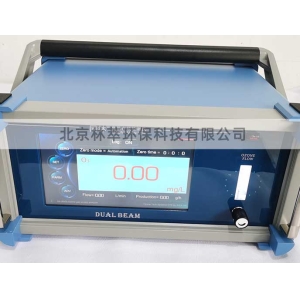
- UV absorption analyzers are the gold standard for process monitoring (0–200 g/m³) and cleanroom trace detection (0–1 ppm). They offer excellent long-term stability and selectivity. Browse our UV ozone analyzers for more details.
- Electrochemical sensors are widely used in 0–1 ppm and 0–10 ppm safety monitors because of their low cost and small size. They require regular calibration but are ideal for personal and area safety.
For Dissolved Ozone Applications
- Membrane-covered amperometric sensors provide real-time, in-line measurement of dissolved O&sub3; in mg/L, suitable for pharmaceutical and semiconductor water systems. See our dissolved ozone monitor portfolio.
- Colorimetric (DPD) test kits are commonly used for spot-checking and validation against online readings.
For Ambient Air & IAQ
Wall-mounted monitors for indoor air quality typically use electrochemical cells in the 0–1 ppm range, with selectable display in ppm or mg/m³.
Common Mistakes to Avoid
- Mixing gas and liquid units: 1 ppm of gas-phase ozone is not 1 mg/L of dissolved ozone. Always verify the phase before recording a value.
- Ignoring temperature and pressure: mg/m³ readings shift with ambient conditions. For compliance reporting, use values corrected to reference conditions (25 °C, 101.325 kPa).
- Forgetting sensor range: a 0–10 ppm electrochemical sensor exposed to 50 ppm O&sub3; will saturate or be permanently damaged. Choose a sensor range at least twice your expected maximum.
Conclusion
Understanding ozone concentration units is the first step toward accurate process control, regulatory compliance, and worker safety. As a rule of thumb:
- Use ppm for workplace gas safety.
- Use ppb for ambient and indoor air quality.
- Use mg/m³ or g/m³ for European regulatory and high-concentration generator reporting.
- Use mg/L for dissolved ozone in water.
Pair the correct unit with the right sensor technology, and your ozone monitoring program will deliver reliable, defensible data. For guidance on selecting equipment for your specific application, contact our team or request a product quotation.
 Why Does an Ozone Analyzer Nee
 UV Ozone Analyzers in Semicond
 How Often Should You Calibrate
 Ozone Monitoring in Cleanroom