
Introduction to the Light Source Structure of UV Ozone Analyzers
Introduction to the Light Source Structure of UV Ozone Analyzers
UV absorption is one of the most widely used methods for industrial ozone detection. Its core principle relies on the absorption characteristic of ozone at 254 nm ultraviolet wavelength, where ozone concentration is calculated by measuring the change in light intensity.
In a UV ozone analyzer, the light source system determines the instrument's stability and detection accuracy. A stable UV light source must ensure accurate output wavelength, long-term light intensity stability, and minimize the effects of temperature and voltage fluctuations.
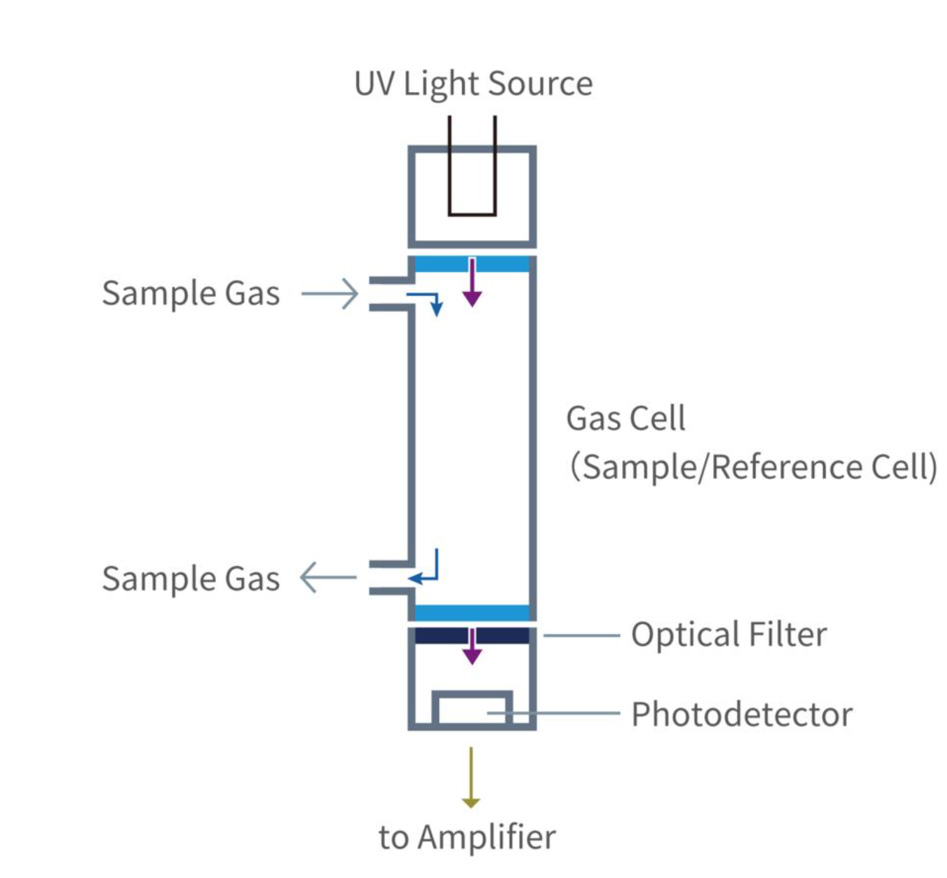
1. What Light Source Do UV Ozone Analyzers Use?
Most high-precision ozone analyzers currently use low-pressure mercury lamps as the 254 nm UV light source.
When a low-pressure mercury lamp operates, the mercury vapor inside is excited by an electric field. Electrons collide with mercury atoms and emit UV light at specific wavelengths, among which the 254 nm spectral line is highly stable and therefore used for ozone concentration detection.
Compared with ordinary UV lamps, low-pressure mercury lamps offer: stable 254 nm output; narrow spectral range; minimal drift during long-term operation; and suitability for continuous online detection.
2. Main Components of the Light Source Module
The light source section of a typical UV ozone analyzer includes:
Component | Function |
Low-pressure mercury lamp | Generates 254 nm UV light |
Constant-current drive circuit | Ensures stable lamp output |
Quartz window | Ensures UV light transmission |
Optical filter | Reduces interference from other wavelengths |
Collimation structure | Improves optical path consistency |
Among these, quartz material is particularly important. Ordinary glass absorbs a large amount of UV light and cannot meet the requirements of 254 nm detection. For this reason, quartz optical components are typically used in the detection light path.
3. Why Is 254 nm UV Light Needed?
Ozone has a distinct absorption peak near 254 nm.
During detection, UV light passes through an absorption cell containing ozone gas:
The relationship between light intensity and concentration follows the Lambert-Beer law:
The higher the ozone concentration, the stronger the UV absorption, and the lower the detected light intensity.
Ozone concentration can be calculated by comparing the difference in light intensity before and after passing through the absorption cell.
4. Light Source Stability Affects Detection Results
During long-term operation of a UV ozone analyzer, the light source is affected by the following factors:
• Lamp aging leading to decreased light intensity;
• Power supply fluctuations causing output variations;
• Temperature changes affecting lamp operating state;
• Contamination of the lamp window reducing transmittance.
Therefore, high-precision instruments typically incorporate:
• Constant-current drive;
• Light source warm-up period;
• Reference light detection;
• Automatic zero calibration.
These design features reduce long-term drift and improve detection repeatability.
5. Light Source Design for High-Concentration Ozone Detection
For laboratory and industrial ozone generator outlet detection, ozone concentration can reach tens or even hundreds of mg/L.
High-concentration ozone strongly absorbs 254 nm UV light. If the absorption cell is not properly designed, the following issues may occur:
• Light intensity approaching zero;
• Signal saturation;
• Distorted concentration measurements.
Therefore, high-concentration ozone detectors typically require:
• Optimized absorption cell length;
• Controlled detection optical path;
• High-sensitivity photoelectric detectors;
• Appropriate measurement range design.
For example, an ozone analyzer with a 0–200 mg/L range differs significantly from ppm-level ozone detectors used in ambient air in terms of light source power, optical path design, and signal processing.
6. Can UV LEDs Replace Mercury Lamps?
In recent years, 254 nm UV LEDs have gradually been applied to small ozone sensors.
They offer advantages such as small size, long service life, and mercury-free operation. However, in the field of high-precision ozone analysis, low-pressure mercury lamps still remain the mainstream.
The reasons are:
• Higher UV output power;
• More mature long-term stability;
• Extensive industrial application experience.
Summary
Although the light source system of a UV ozone analyzer has a simple structure, it directly affects detection accuracy.
A stable 254 nm UV light source, a reliable optical structure, and a reasonable absorption cell design are the key to achieving high-precision ozone concentration measurement.
For scientific research ozone systems, ozone generator outlet detection, and online ozone monitoring equipment, light source stability is also an important indicator for evaluating instrument performance.
 Why Does an Ozone Analyzer Nee
 UV Ozone Analyzers in Semicond
 How Often Should You Calibrate
 Ozone Monitoring in Cleanroom