
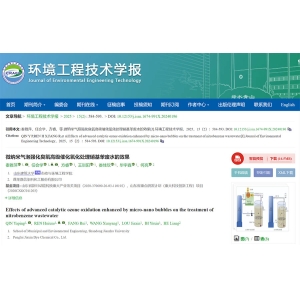
Effects of advanced catalytic ozone oxidation enhanced by micro-nano bubbles on the treatment of nitrobenzene wastewater
1. Article information
Title: Effects of advanced catalytic ozone oxidation enhanced by micro-nano bubbles on the treatment of nitrobenzene wastewater
2. Article link
DOI: 10.12153/j.issn.1674-991X.20240196
3. Journal Information
Journal Name: Journal of Environmental Engineering and Technology
4. Author Information: QIN Yaping1, REN Huixue1, FANG Rui1, WANG Xunyang1, LOU Jiaxin1, BI Yuxin1, HE Liang2
1.School of Municipal and Environmental Engineering, Shandong Jianzhu University
2.Penglai Jiaxin Dye Chemical Co., Ltd.
5. The product model used in the text: 3S-J5000
Abstract: Ozone is inefficient in degrading pollutants through traditional aeration methods, and its combination with micro-nano bubble technology can significantly improve oxidation efficiency. Taking nitrobenzene wastewater as an example, the degradation effect of ozone on nitrobenzene before and after adding Mn/Mg/Ce@Al2O3 catalyst under micro-nano bubbles and traditional aeration conditions was studied separately. The free radical quenching test was designed to analyze the reaction mechanism. The main influencing factors were analyzed by the response surface method and the test conditions were optimized. Results showed that the particle size of micro-nano bubbles produced by the pressurized gas dissolution and release method was uniform, and the particle size of most bubbles was 437.3 nm, and the Zeta potential was −28.11 mV. In the micro-nano bubbles-enhanced ozone catalytic oxidation process, the solubility of ozone reached 13.50 mg/L, which was 130.8% higher than that of traditional aeration. The results of free radical quenching test confirmed that in the process of ozone catalytic oxidation, hydroxyl radicals and superoxide radicals were mainly produced to carry out advanced oxidation of pollutants. After adding Mn/Mg/Ce@Al2O3 catalyst, compared with the traditional aeration method, the removal rate of nitrobenzene wastewater with the initial concentration of 200 mg/L by ozone micro-nano bubbles was increased 18.65%. The response surface method optimization and verification results showed that with the temperature at 25 ℃, pH of 8.2, Mn/Mg/Ce@Al2O3 catalyst dosing quantity of 23 g/L, the ozone micro-nano bubbles removal efficiency of nitrobenzene was the highest, which could reach 89.42%. The results can provide a feasible direction for the development of enhanced ozone advanced oxidation.
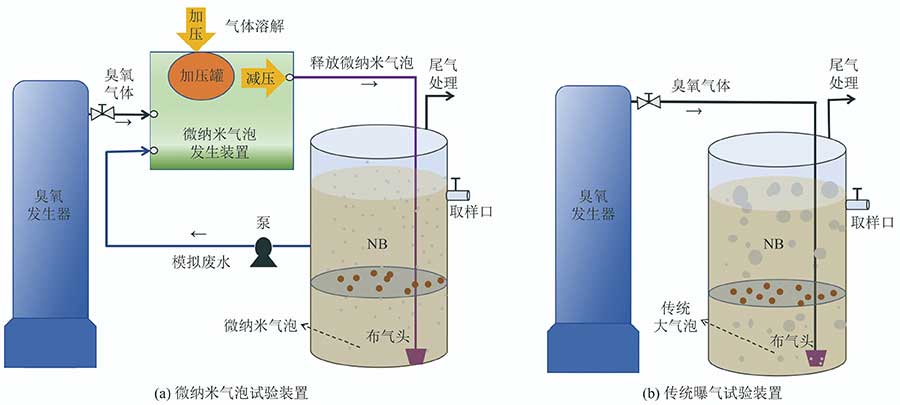
Schematic diagram of experimental device
 Bridging Dissolved Organic Mat
 Study on the Efficient Product
 Green aromatic aldehydes produ
 Effects of advanced catalytic