
Bridging Dissolved Organic Matter Reactivity to Ozonation Catalysts for Cu@Al2O3 from the Molecular Level by Machine Learning
Bridging Dissolved Organic Matter Reactivity to Ozonation Catalysts for Cu@Al2O3 from the Molecular Level by Machine Learning
1. Article information
Title:Bridging Dissolved Organic Matter Reactivity to Ozonation Catalysts for Cu@Al2O3 from the Molecular Level by Machine Learning
2. Article link
DOI: https://doi.org/10.1021/acs.est.5c07324
3. Journal Information
Journal Name: Environmental Science & Technology
4. Author Information:Liya Fu,Junkai Wang,Liyan Deng,Kairui Cheng,Xiuwei Ao,Changyong Wu*
State Key Laboratory of Environmental Criteria and Risk Assessment, Chinese Research Academy of Environment Sciences, Beijing 100012, China
Research Center of Environmental Pollution Control Engineering Technology, Chinese Research Academy of Environment Sciences, Beijing 100012, China
5. The product model used in the text: 3S-J5000 ozone monitor
ABSTRACT:
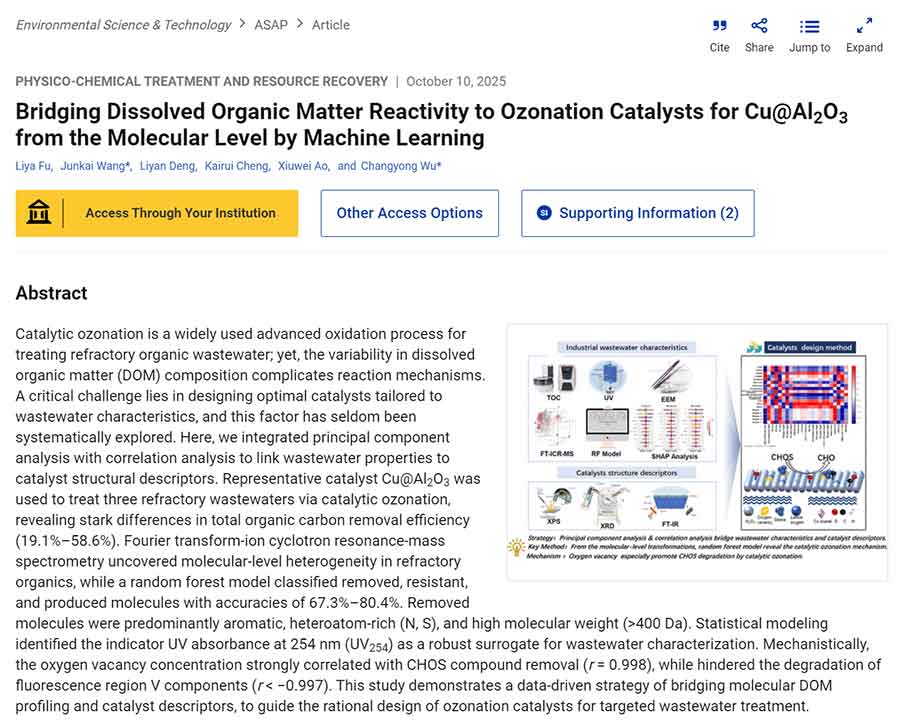
Catalytic ozonation is a widely used advanced oxidation process for treating refractory organic wastewater; yet, the variability in dissolved organic matter (DOM) composition complicates reaction mechanisms. A critical challenge lies in designing optimal catalysts tailored to wastewater characteristics, and this factor has seldom been systematically explored. Here, we integrated principal component analysis with correlation analysis to link wastewater properties to catalyst structural descriptors. Representative catalyst Cu@Al2O3 was used to treat three refractory wastewaters via catalytic ozonation, revealing stark differences in total organic carbon removal efficiency (19.1%–58.6%). Fourier transform-ion cyclotron resonance-mass spectrometry uncovered molecular-level heterogeneity in refractory organics, while a random forest model classified removed, resistant, and produced molecules with accuracies of 67.3%–80.4%. Removed molecules were predominantly aromatic, heteroatom-rich (N, S), and high molecular weight (>400 Da). Statistical modeling identified the indicator UV absorbance at 254 nm (UV254) as a robust surrogate for wastewater characterization. Mechanistically, the oxygen vacancy concentration strongly correlated with CHOS compound removal (r = 0.998), while hindered the degradation of fluorescence region V components (r < −0.997). This study demonstrates a data-driven strategy of bridging molecular DOM profiling and catalyst descriptors, to guide the rational design of ozonation catalysts for targeted wastewater treatment.
 Bridging Dissolved Organic Mat
 Study on the Efficient Product
 Green aromatic aldehydes produ
 Effects of advanced catalytic