
A novel catalytic membrane integrated with ozone process for secondary wastewater treatment: Micropollutant removal, membrane fouling control, and its mechanisms
A novel catalytic membrane integrated with ozone process for secondary wastewater treatment: Micropollutant removal, membrane fouling control, and its mechanisms
1. Article information
Title A novel catalytic membrane integrated with ozone process for secondary wastewater treatment: Micropollutant removal, membrane fouling control, and its mechanisms
Chinese Title: A Novel Catalytic Membrane Integrated with Ozone Process for Secondary Wastewater Treatment: Micro-pollutant Removal, Membrane Fouling Control and Its Mechanism
2. Article link
https://doi.org/10.1016/j.desal.2023.116869
3. Journal Information
Journal Title: Desalination Volume 565, November 2023, 116869
4. Author Information: Yuan He a b, Zhan Chen a, Xia Huang a, Xiaomao Wang a, Xianghua Wen a
a.School of Environment, Tsinghua University, Beijing 100084, China
b.China National Institute of Standardization, Beijing 100191, China
5. The product model used in the text: 3S-J5000
Key point
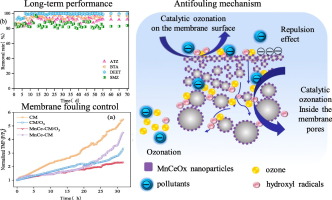
Within 70 days, the O3/MnCe CM process can effectively remove four representative micro-pollutants and performs well in the removal of traditional pollutants
The O3/MnCe CM process is sufficient to achieve stable and effective operation when treating actual wastewater containing micro-pollutants.
The O3/MnCe CM process improves TMP control, especially reducing the resistance to irreversible scaling.
The anti-fouling mechanism of the O3/MnCe CM process has been proposed as the reduction of isoelectric point, catalytic ozone oxidation on the membrane surface and in the pores, and ozone oxidation in the membrane tank.
Abstract
The integration of membrane filtration and catalytic ozonation is increasingly investigated in micro-polluted wastewater treatment, whereas membrane fouling still inhibits its practical application. In the present study, a novel MnCe-catalytic membrane integrated with ozone process (O3/MnCe-CM) was established and applied to remove four micropollutants from the real secondary effluent in continuous operation. Efficient removal of four representative micropollutants with the removal rate ranging from 89.33 % to 99.49 % and superior performance on conventional pollutants, with the DOC, UV254, polysaccharide, and protein reduced by 30 %, 88 %, 32.5 %, and 24 %. The O3/MnCe-CM process had an improved TMP control effect, explicitly reducing the irreversible fouling resistance given a Rir/Rt of 10.17 % which is 42.9 % of that of the O3/CM process. After filtering for 70 days, the TMP only increased by 24.51 kPa. More importantly, the antifouling mechanism was proposed as the combined effects of the decrease of the membrane isoelectric point that elevated its repulsion towards pollutants and the catalytic ozonation that reduced the organic foulants accumulated on the membrane surface and inside the pores. In addition, ozonation in the membrane tank decreased the pollutant load passing through MnCe-CM. In all, the present study provides a novel O3/MnCe-CM process with a promising application perspective.
Ozone equipment: 3S-J5000 ozone online detector
 Bridging Dissolved Organic Mat
 Study on the Efficient Product
 Green aromatic aldehydes produ
 Effects of advanced catalytic