
Dissolved Ozone Monitor vs ORP: What Each One Actually Tells You
Dissolved Ozone Monitor vs ORP: What Each One Actually Tells You
Two sensors sit on the same water line. One reads "0.35 ppm", the other reads "650 mV", and both are connected to ozone disinfection. If you have ever stood in front of a control panel wondering which number to trust, read on. Oxidation-reduction potential (ORP) and a dissolved ozone monitor answer different questions about the same water, and mixing them up leads to overfed generators, under-dosed loops, and confusing audit conversations. Here is what each sensor really measures, where each one is the right tool, and how the two work together in a well-run ozone water system.
What ORP actually measures
An ORP sensor is a small voltmeter for water chemistry. A noble-metal electrode (usually platinum or gold) and a reference electrode report the electrical potential of the water in millivolts. That potential reflects the balance between oxidizing and reducing species in the sample.
The key word is overall. ORP does not know what an ozone molecule looks like. It responds to every oxidizer in the water: ozone, dissolved oxygen, chlorine residuals, chloramines, permanganate, anything with oxidation power. It also shifts with pH, because the same oxidant produces a lower ORP reading at higher pH. In other words, ORP is a chemistry-wide summary, not an ozone-specific number.
That non-specificity is the design: ORP was developed as a cheap, robust indicator of whether water has net oxidizing power.
What a dissolved ozone monitor actually measures
A dissolved ozone monitor answers a narrower question: how much ozone is physically dissolved in this water right now, in ppm or ppb? The two common measurement routes are:
1. Membrane-covered amperometric sensors. Ozone diffuses through a membrane and is reduced at an electrode; the resulting current is proportional to the ozone partial pressure. Good designs compensate for temperature and flow, and the membrane keeps most other chemistry out, which is what gives the sensor its ozone selectivity.
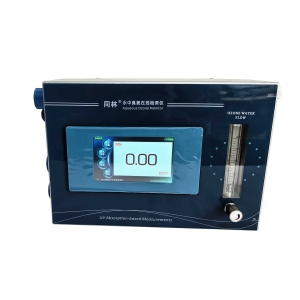
2. UV absorption. Ozone absorbs ultraviolet light at 254 nm, the same principle used in gas-phase photometric analyzers; the water sample passes through a flow cell and the instrument reads the light loss directly. UV-based instruments are the usual choice when the reading has to be defensible, such as in high-purity and pharmaceutical water systems. This is the technology behind our dissolved ozone monitor product line.
Because the measurement is specific to ozone, a dissolved ozone monitor can tell the difference between "ozone decayed to zero" and "ozone is fine but something else is pushing the potential up". That distinction is invisible to ORP.
Side by side: what you gain and what you give up
The table below puts the two sensors next to each other.
| Aspect | ORP sensor | Dissolved ozone monitor |
|---|---|---|
| What it reports | Millivolts (overall oxidation potential) | ppm or ppb ozone |
| Ozone-specific? | No — responds to all oxidizers | Yes |
| pH sensitivity | Reading shifts with pH | Minimal for the ozone reading itself |
| Response to chlorine or other oxidizers | Reads as additional oxidizing power | Ignores them (membrane designs); UV designs read ozone only |
| Cost and upkeep | Lower cost, simple maintenance | Higher cost, needs flow, membrane/electrolyte care or lamp stability checks |
| Typical role | Disinfection assurance, simple control loops | Process control, dosing verification, validation-grade records |
When ORP is enough
Plenty of successful ozone systems run on ORP alone, and that is legitimate when the conditions fit:
1. One dominant oxidizer, controlled chemistry. In a system where no other disinfectant is present and the water chemistry is stable, the ORP number moves up and down with ozone in a repeatable way. If the plant has established, from experience, which ORP window means adequate disinfection in its own water, controlling to that window works.
2. Multiple disinfectants in one loop. ORP can be the better choice when ozone shares a line with chlorine or other oxidants and the goal is total disinfection assurance: it sums the protective power of everything present, while an ozone-specific reading would ignore the rest.
3. Budget and staffing limits. ORP electrodes are inexpensive, standardize quickly, and tolerate rough treatment. For small systems without instrument technicians, a sensor a general maintenance person can keep healthy is the one that actually stays in service.
When you need a real ozone number
ORP stops being enough the moment the ozone value itself becomes the thing you manage, verify, or document:
1. Dosing and decay control. Ozone decays in water, and the decay rate depends on temperature, organic load, and pH. To hold a residual through a contact loop or at a point of use, you need the residual, not a potential. A dissolved ozone monitor lets you see decay curves, size dosing, and catch a weakening generator before the residual collapses. Our overview of ozone monitoring in water treatment covers this control problem in more depth.
2. Telling oxidizers apart. Suppose an ORP panel reads high but the ozone monitor reads zero. That combination means the oxidizing power is coming from something other than ozone — a chlorine crossover, a dosing mistake upstream, or residual chemistry in reused water. Only the ozone-specific sensor can make that call. The reverse pattern (ozone present but ORP low) usually points to a heavy reducing load consuming oxidizer capacity faster than it is added, or to a fouled ORP electrode.
3. Documentation and audits. When a customer, a regulator, or an internal quality system asks "what was your ozone residual?", a millivolt number is hard to defend. Ozone concentration in ppm or ppb, measured by a method with traceable behavior — for example the indigo colorimetric method described in Standard Methods for the Examination of Water and Wastewater — is the form those records are expected to take.
4. High-purity and pharmaceutical water. In purified water and water-for-injection loops, ozone residuals are specified in ppb and sanitization cycles are validated against them. ORP cannot resolve ppb differences or distinguish ozone from the loop's other chemistry. This is where dedicated instruments earn their cost, supported by the calibration discipline described in how often to calibrate an ozone detector.
Running both sensors together
Many serious ozone installations use ORP and a dissolved ozone monitor side by side, each doing the job it is good at. A workable arrangement looks like this:
1. Ozone monitor at the control point. Put the ozone-specific instrument where the residual matters — after the contact loop, at the point of use, or on the return line — and let it drive dosing. Installation details such as sample take-off position and cell flow are covered in our guide to installing a dissolved ozone monitor in a water line.
2. ORP as the sentinel. Keep an ORP sensor as a low-cost sanity check. When both sensors move together, the system is behaving; when they diverge, the divergence itself is the alarm.
3. Map the relationship once. During commissioning, record dissolved ozone and ORP pairs across the normal operating range. That mapping becomes your baseline: a sudden change in the ORP-to-ozone relationship often signals changing water quality or a drifting sensor.
4. Maintain them on different schedules. ORP electrodes need periodic cleaning and standardization against an ORP test solution; ozone sensors need membrane, electrolyte, or lamp attention depending on type. Treat them as two instruments with two maintenance calendars.
A practical decision checklist
If you are choosing between the two, work through these questions in order:
1. Is the ozone value itself specified, controlled, or documented anywhere in your process? If yes, you need a dissolved ozone monitor.
2. Are other oxidizers regularly present in the water? If they are and you care about total disinfection power, ORP covers it; if you care about ozone specifically, only an ozone-specific sensor will do.
3. Does the application involve ppb-level residuals or validation records? Then a dedicated instrument with UV or membrane amperometric measurement is the appropriate class of equipment.
4. Is there budget for one sensor only, in a stable single-oxidizer system? ORP, backed by occasional grab-sample verification, is a defensible minimum.
5. Can you support two instruments? If yes, the combined setup gives you chemistry awareness plus ozone truth, a stronger position than either sensor alone.
The bottom line
ORP and dissolved ozone monitoring are not competitors; they are answers to different questions. ORP tells you whether the water, as a whole, has net oxidizing power — cheaply, robustly, and with no idea of which molecule is responsible. A dissolved ozone monitor tells you exactly how much ozone is in the water, which is what dosing control, decay management, and validation records actually require. When the two numbers agree, you have both assurance and evidence. When they disagree, you have early warning that the water chemistry — or one of the sensors — needs a closer look.
If you are planning instrumentation for an ozone water system, contact our team with your flow, residual targets, and water chemistry, and we can suggest a measurement layout that fits. For broader context on water treatment and disinfection practice, the World Health Organization's drinking water quality guidelines are a useful independent reference.
 Confined Space Entry and Ozone
 How Do You Prepare Zero Air an
Can You Install an Ozone Monit
 When Should You Replace the UV