
Degradation of Bisphenol A by ozonation in a rotating packed bed: Modeling by response surface methodology and artificial neural network
旋转填料床中臭氧化降解双酚 A:通过响应面法和人工神经网络建模
Lei Wang a, Chu Qi b, Yuan Lu c, Moses Arowo d, Lei Shao a
a. Research Center for Supergravity Engineering and Technology, Ministry of Education, Beijing University of Chemical Technology, Beijing 100029, China
b. School of Information Science and Technology, Beijing University of Chemical Technology, Beijing 100029
c. Tianjin Zhongneng Petrochemical Co., LTD., Tianjin 300450
d. Department of Chemical and Process Engineering, Moi University, Eldoret, 3900, Kenya
"Emphasize
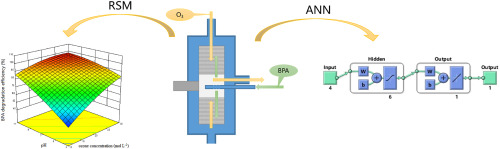
Both RSM and ANN can predict the ozonation modeling of BPA in RPB very well.
RSM is slightly superior to ANN in simulating the ozonation of BPA.
Ozone concentration and pH value have a significant interactive effect on the degradation of BPA.
The rotational speed of RPB and other variables have no significant effect on the degradation of BPA.
Abstract
The ozonation process of bisphenol A (BPA) in a rotating packed bed (RPB) was modeled using the response surface method (RSM) and artificial neural network (ANN). The experiment adopted a Box-Behnken design to investigate the interactive effects of parameters such as ozone concentration, pH, RPB rotational speed, and liquid flow rate on the degradation efficiency of bisphenol A. The interaction between ozone concentration and pH on the degradation efficiency of bisphenol a was significant, while the interaction between RPB rotational speed and other variables was not significant. A second-order polynomial equation for the degradation efficiency of bisphenol A was established. Based on the RSM experimental data, a multi-layer feedforward neural network model was constructed. The correlation coefficient of latent layer neurons is very high (RANN = 0.99158). The comparison between the RSM model and the ANN model indicates that both can accurately predict the degradation efficiency of BPA (RRSM = 0.99559). Under the conditions of ozone concentration of 20 mg L−1, pH of 11, liquid flow rate of 10 L h−1, and RPB rotational speed of 800 rpm, the degradation efficiency of bisphenol a was very high, reaching 99.52%. Both the RSM model (99.54%) and the ANN model (99.82%) could predict this result very well. However, the coefficient of determination of the RSM model is relatively high (R2RSM = 0.9912, R2ANN = 0.9827), and the mean square error is relatively low (MSERSM = 0.0001684, MSEANN = 0.0003305). Therefore, the RSM model is slightly superior to the artificial neural network model.
Experimental procedures
Ozone is produced by the ozone generator (3S-A10, Tonglin Tech Co., Ltd., Beijing, China), with an oxygen source of 99.5%
Its concentration was measured using an analyzer (3S-J5000, Tonglin Tech Co., Ltd., Beijing, China).
Source: https://www.sciencedirect.com/science/article/abs/pii/S0045653521021743
 Bridging Dissolved Organic Mat
 Study on the Efficient Product
 Green aromatic aldehydes produ
 Effects of advanced catalytic