
Novel catalytic ceramic membranes anchored with MnMe oxide and their catalytic ozonation performance towards atrazine degradation
Novel catalytic ceramic membranes anchored with MnMe oxide and their catalytic ozonation performance towards atrazine degradation
Yuan He a, Liangjie Wang a b, Zhan Chen a, Xia Huang a, Xiaomao Wang a, Xiaoyuan Zhang a, Xianghua Wen a
School of Environment, Tsinghua University, Beijing 100084
State Key Laboratory of Environmental Standards and Risk Assessment, Chinese Research Academy of Environmental Sciences, Beijing 100012, China
"Prominent
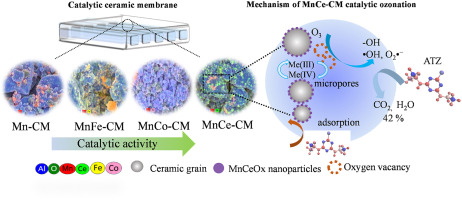
A new type of catalytic ceramic membrane impregnated with MnMe oxide (Me = Fe, Co, Ce) was successfully prepared.
Due to the oxygen vacancies produced by Ce, the atrazine removal rate of MnCe-CM is very high for 3+/CE4+ and Mn2+/ manganese 3+.
Due to its high specific surface area and closed space, the catalytic ozonation of the entire membrane is highly effective.
The transformation pathway of atrazine and the biological toxicity of its products were determined.
Abstract
In this study, MnMe oxide (Me = Fe, Co, Ce) was in-situ embedded in the membrane surface and micropores through REDOX reactions to prepare a new type of catalytic ceramic membrane. The synergistic degradation effect of membrane filtration and catalytic ozonation on atrazine was investigated. Among the four membranes, due to the oxygen vacancies formed by Ce3+/Ce4+ and Mn2+/Mn3+, the removal rate of atrazine by mce-cm reached 99.99% within 40 minutes. Subsequently, mce-cm was selected for optimization operation, with an ozone concentration of 0.8 mg/min and a pH of 7. As the catalyst was successfully embedded in the surface and micropores of mce-cm, catalytic ozonation occurred simultaneously in the micropores and on the surface. The high specific surface area provides sufficient reaction sites, and the closed space is conducive to the contact between •OH and reactants, which proves that the reactions on the microporous surface and inside the micropores are very effective. In addition, based on the identified by-products, the degradation pathway of atrazine was proposed. The reaction sites and biological toxicity evaluations were calculated respectively by using density functional theory (DFT) and toxicity assessment software (T.E.S.T). This study presents a novel MnCe-CM with dual functions of filtration and catalytic ozonation, and Outlines the synergistic effects of separation and catalytic ozonation.
The ozone analyzer was used for (3S-J5000, Tonglin Technology, China)
Source: https://www.sciencedirect.com/science/article/pii/S0376738822001090
 Bridging Dissolved Organic Mat
 Study on the Efficient Product
 Green aromatic aldehydes produ
 Effects of advanced catalytic