
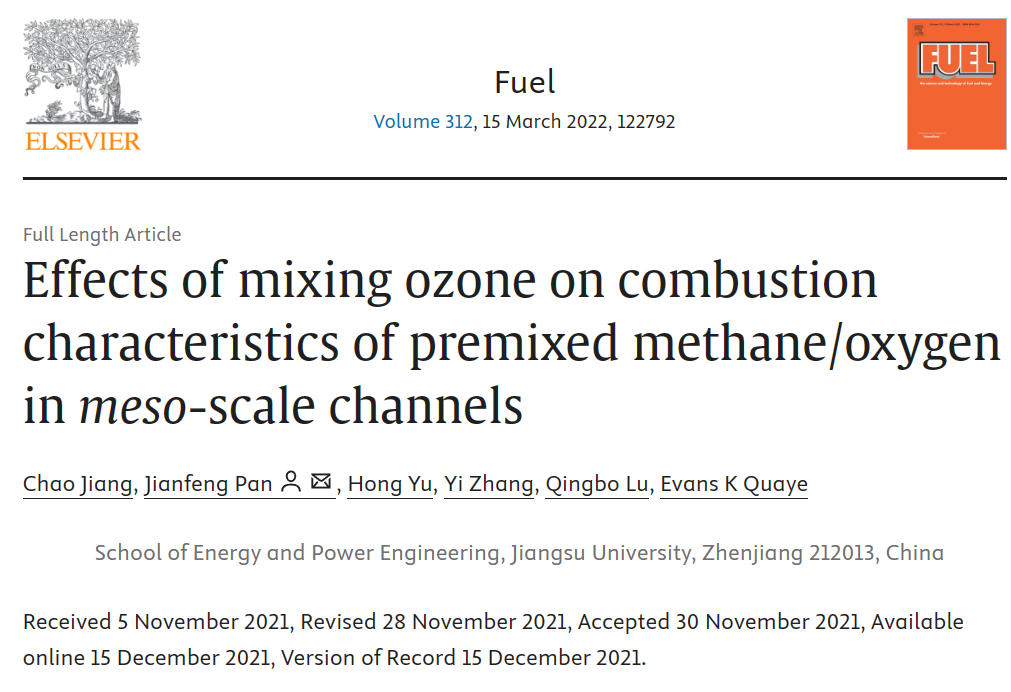
Effects of mixing ozone on combustion characteristics of premixed methane/oxygen in meso-scale channels
Effects of mixing ozone on combustion characteristics of premixed methane/oxygen in meso-scale channels
1. Article information
Title: Effects of mixing ozone on combustion characteristics of premixed methane/oxygen in meso-scale channels
The influence of Mixed Ozone on the Premixed Combustion Characteristics of Methane/Oxygen in Mesoscale channels
2. Article link
https://doi.org/10.1016/j.fuel.2021.122792
3. Journal Information
Journal Title: Volume 312, 15 March 2022, 122792
4. Author Information: Chao Jiang, Jianfeng Pan, Hong Yu, Yi Zhang, Qingbo Lu, Evans K Quaye
School of Energy and Power Engineering, Jiangsu University, Zhenjiang 212013, China
5. The product models used in the text: 3S-T3 ozone generator,3S-J5000 ozone detector
To study the influence of ozone on the combustion characteristics of methane/oxygen premixes in mesoscale channels, the flammability limit of the ozone mixture was obtained through experiments, and the effect of ozone concentration on the near-limit combustion process was analyzed from the perspectives of thermal effect and chemical kinetics effect through numerical simulation. In addition, the changes in OH radicals, outer wall temperature and wall heat loss in the mixed ozone were also compared. The results show that the addition of ozone significantly broadens the flammability limit of methane/oxygen, raises the reaction temperature, and moves the combustion zone towards the intake passage. In addition, the chemical effect of ozone is more significant than its thermal effect. The O atoms produced by the decomposition of ozone interact with fuel molecules, significantly increasing the concentration of free radicals such as OH, further accelerating the side chain reaction and enhancing the entire combustion process. However, due to the sharp increase in radiant heat, the total heat loss has increased by 4% to 8%. Furthermore, the research found that under non-stoichiometric conditions and at low inlet flow rates, the increase in OH radicals and the temperature of the outer wall is more pronounced, and the heat loss of the wall surface is also relatively large.
Test device
Figure 1 is a schematic diagram of the experimental setup, including the gas supply system, gas flow control system and data acquisition and processing system. Methane and oxygen with a purity greater than 99.99% are respectively released from the corresponding steel cylinders, and then the outlet pressure is reduced to 0.2 MPa through a pressure reducing valve. In the experiment, part of the O2 was converted into O3 through the ozone generator (3S-T3) and the ozone concentration tester (3S-J5000).
 Bridging Dissolved Organic Mat
 Study on the Efficient Product
 Green aromatic aldehydes produ
 Effects of advanced catalytic