
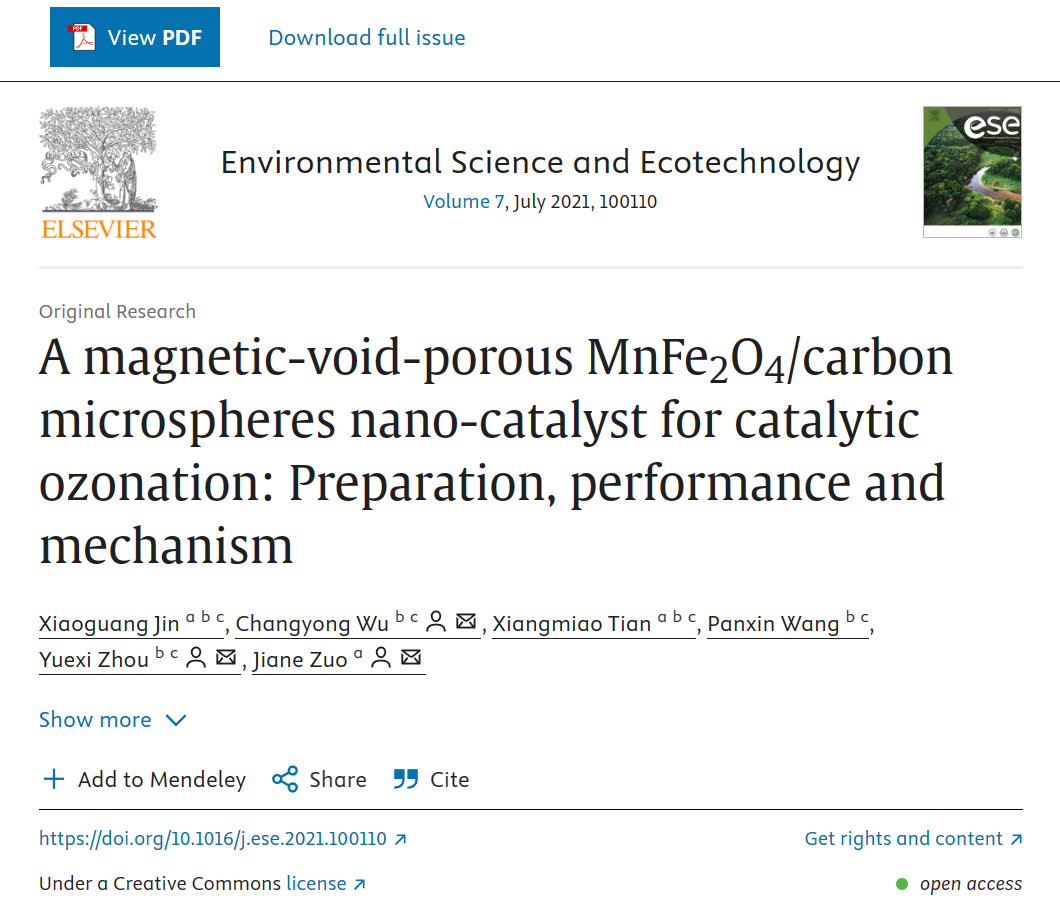
A magnetic-void-porous MnFez04/carbon microspheres nano-catalyst for catalytic ozonation: Preparation, performance and mechanism
A magnetic-void-porous MnFez04/carbon microspheres nano-catalyst for catalytic ozonation: Preparation, performance and mechanism
Abstract
Sewage treatment is of vital importance to safeguarding human health and ecological security. Ozonation catalyzed by nano-catalysts is a highly efficient treatment technology that has been widely studied. However, this method has always been limited by the disadvantages of nanocatalytes, such as easy loss, difficulty in separation and reuse, and catalytic capacity decline due to polymerization, which may cause serious waste of resources and pose potential risks to human health and ecosystems. To address these issues, a magnetic-porous MnFe2O4/ carbon microsphere shell nanoccatalyst (CMS-MnFe2O4) was successfully synthesized using renewable natural microalgae. The separation experiment shows that under the action of an external magnetic field, CMS-MnFe2O4 can be rapidly separated within 2 minutes. During the catalytic ozonation of oxalic acid (OA), CMS-MnFe2O4 demonstrated highly efficient and stable catalytic efficiency, with the maximum removal rate of total organic carbon reaching 96.59%, and still maintained an efficiency of 93.88% after 4 cycles. The stable catalytic efficiency is attributed to the supporting effect of the carbon microsphere shell, which significantly enhances the chemical stability of CMS-MnFe2O4 and reduces the metal ion leaching rate to 10-20% of MnFe2O4 through electron transfer. To explore its catalytic mechanism, we conducted free radical experiments and proposed a new OA degradation pathway involving superoxide anions rather than hydroxyl radicals. Therefore, this study indicates that a highly efficient, recyclable, stable and durable catalytic ozonation catalyst can be prepared.
Catalytic ozonation processThe ozonation experiments were carried out in a laboratory-scale reactor (ca. 1.5 L) equipped with agitation. Ozone was pro-duced using pure oxygen in an ozone generator (3S-A3, Tonglin,China) monitored with an ozone analyzer (3S-J5000, Tonglin,China), and continuously bubbled into the OA solution through aporous titanium alloy aerator. Ozone leaving the reactor wasremoved with an ozone destructor
Extracted from:
Xiaoguang Jin a b c, Changyong Wu b c, Xiangmiao Tian a b c, Panxin Wang b c, Yuexi Zhou b c, Jiane Zuo a
a.State Key Joint Laboratory of Environment Simulation and Pollution Control, School of Environment, Tsinghua University, Beijing, 100084, China
b.State Key Laboratory of Environmental Criteria and Risk Assessment, Chinese Research Academy of Environmental Sciences, Beijing, 100012, China
c.Research Center of Environmental Pollution Control Engineering Technology, Chinese Research Academy of Environment Sciences, Beijing, 100012, China
The ozone equipment used is: 3S-A3 ozone generator and 3S-J5000 ozone detector.
 Bridging Dissolved Organic Mat
 Study on the Efficient Product
 Green aromatic aldehydes produ
 Effects of advanced catalytic