
Rapid degradation of refractory organic pollutants by continuous ozonation in a micro-packed bed reactor
Rapid degradation of refractory organic pollutants by continuous ozonation in a micro-packed bed reactor
1. Article information
Title: Rapid degradation of refractory organic pollutants by continuous ozonation in a micro-packed bed reactor
2. Article link
https://doi.org/10.1016/j.chemosphere.2020.128621
3. Journal Information
Journal Name: Chemosphere Volume 270, May 2021, 128621
4. Author Information: Qiang Cao b c, Le Sang a, Jiacheng Tu a, Yushi Xiao b, Na Liu b c, Lidong Wu b, Jisong Zhang a
a.The State Key Lab of Chemical Engineering, Department of Chemical Engineering, Tsinghua University, Beijing, 100084, China
b.Key Laboratory of Control of Quality and Safety for Aquatic Products, Ministry of Agriculture, Chinese Academy of Fishery Sciences, Beijing, 100141, China
c.College of Food Science and Technology, Shanghai Ocean University, Shanghai, 201306, China
5. The product models used in the text: 3S-t3, 3S-J5000
Key points
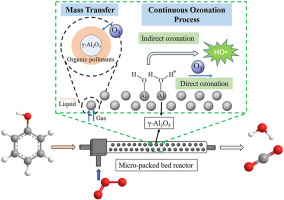
A continuous ozonation system based on μPBR has been developed for the rapid degradation of refractory organic pollutants.
Compared with large-scale reactors, the apparent degradation rate constant has increased by 1 to 2 orders of magnitude.
Within 71 seconds, the removal rates of pollutants and COD by μPBR reached 100% and 70% to 80% respectively.
The higher gas-liquid mass transfer in μPBR can enhance the removal rates of pollutants and COD.
Abstract
In recent years, microreactor technology has attracted much attention due to its excellent multiphase mixing performance and strong mass transfer capacity. The continuous ozonation system using a micro-filled bed reactor (μPBR) has enhanced the dissolution rate of ozone and achieved rapid and efficient degradation of refractory organic pollutants. The effects of liquid flow rate, gas flow rate, initial pH, initial O3 concentration and initial phenol concentration on the removal rates of phenol and chemical oxygen demand (COD) were investigated. The experimental results show that under optimal conditions, the removal rates of phenol and COD are 100.0% and 86.4% respectively. Compared with large-scale reactors, the apparent reaction rate constant of μPBR has increased by 1 to 2 orders of magnitude. In addition, ozonation was used to treat some typical organic pollutants (including phenols, antibiotics and dyes) in μPBR. Within 71 seconds, the removal rates of organic pollutants and COD reached 100.0% and 70.2% - 80.5% respectively. In this continuous treatment system, 100% unreacted ozone is converted into oxygen, promoting the healthy development of aquatic ecosystems. Therefore, this continuous system based on μPBR is a promising method for the rapid and efficient treatment of refractory organic pollutants.
Ozone equipment
The schematic diagram of the continuous ozonation experimental device of the micro-packed bed reactor is shown in Figure 1. All experiments were conducted at room temperature (20℃). Ozone is produced by the ozone generator (Tonglin Technology 3S-T3), and the oxygen supply is pure oxygen. The oxygen flow rate is within the range of 100-200 mL min-1 and is controlled by the float flowmeter (Silian 701HB-5). Before and after the experiment, nitrogen was also provided to purify the entire flow system. The back pressure regulator parallel to the reactor keeps the pressure between 0.2 and 1.0 bar, which is the normal working pressure of the ozone generator.
This back pressure regulator also plays a role in the ozone distribution of the ozone generator.
After passing through the ozone generator, the ozone-oxygen mixture is divided into two parts.
A portion flows into the mPBR at a flow rate of 20-100 sccm through the ozone mass flow controller (Sevenstar DO7-19B).
Another type flows out of the system through the back pressure regulator and is destroyed by ozone destruction.
The ozone monitor (Tonglin Technology 3S-J5000) monitors the concentration of ozone in the gaseous phase.
During the experiment, the ozone concentration ranged from 30 to 130 mg l-1, depending on the inlet pressure, temperature and flow rate. Before the zonal reaction, the initial ozone concentration (gas phase) is first measured by closing the reactor inlet.
The model organic pollutants were conveyed by a plunger pump (Peek 6000LDI-P) at a flow rate of 0.4-2.0 mL min-1.
The gas-liquid mixture at the mPBR outlet is collected in a stopper bottle, where the gas phase and liquid phase are separated. Unreacted ozone is measured by an ozone monitor and partially destroyed by ozone destruction.
When ozone is destroyed, 99.9% of it is converted into oxygen (Table S1). When sampling, switch the three-way ball valve to collect the liquid sample.
The removal rates of pollutants and COD were measured immediately after sample collection. There was little change compared with those measured 24 hours later, remaining within the range of 1-2%.
Therefore, unreacted ozone has no effect on the removal of pollutants and COD.
 Bridging Dissolved Organic Mat
 Study on the Efficient Product
 Green aromatic aldehydes produ
 Effects of advanced catalytic