
Reference: Treatment of Acid Red 73 wastewater by the O3/RSR-BCR process
Reference: Treatment of Acid Red 73 wastewater by the O3/RSR-BCR process
1. Article information
Title: Treatment of Acid Red 73 wastewater by the O3/RSR-BCR process
2. Article link
https://doi.org/10.1016/j.cep.2020.108296
3. Journal Information
Journal Title: Chemical Engineering and Processing-Process Intensification Volume 160, March 2021, 108296
Research direction involved: Chemical Engineering
4. Author Information: Jinmeng Fan a, Fei Fan b, Wei Wang b, Hanxiao Zhang a, Lei Wang a, Jiawei Chang a, Qi Liang b, Dan Wang a, Zhibang Liu a, Lei Shao a
aResearch Center of the Ministry of Education for High Gravity Engineering and Technology, Beijing University of Chemical Technology, Beijing 100029, China
bBeijing Water Business Doctor Co. Ltd., Beijing 100875, China
5. Product models used in the text: 3S-A10, 3S-J5000
Key point
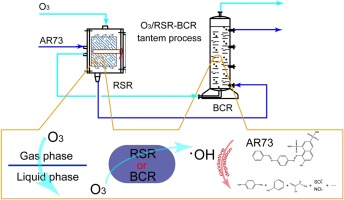
The rotor-stator reactor (RSR) is coupled with the bubble column reactor (BCR) for ozonation.
The O3/RSR-BCR process for degrading Acid Red 73 (AR73).
The degradation efficiencies of AR73 and COD reached over 97% and 30% respectively.
The advantage of the O3/ RSR-BCR process lies in the excellent mass transfer effect of RSR.
Decolorization is achieved by attacking the azo chromogenic groups in AR73 with free radicals do and O3.
Abstract
A rotor-stator reactor (RSR) and a bubble column reactor (BCR) were used in series to treat simulated printing and dyeing wastewater, thereby enhancing the degradation effect of ozone oxidation on acid Red 73 (AR73). The results show that the degradation efficiencies of AR73 and COD by the O3/RSR-BCR process reach over 97% and 30% respectively. Due to the excellent mass transfer effect of RSR, the degradation efficiency of AR73 by the O3/RSR-BCR process is significantly higher than that by the O3/BCR process, demonstrating the effect of reducing ozone consumption and BCR volume due to the shortened liquid residence time. The advantage of the O3/RSR-BCR process in treating AR73 wastewater lies in the high adsorption efficiency of O3 in RSR and the relatively long reaction time between O3 and pollutants in BCR. The results show that the O3/RSR-BCR process is an efficient decolorization technology for printing and dyeing wastewater.
Ozone equipment
The ozone generator (3S-A10, Tonglin Technology Co., LTD., China) generates ozone from the air, and the ozone concentration analyzer (3S-J5000, Tonglin Technology Co., LTD., China) monitors the concentration of gaseous ozone. The ozone-containing gas enters the RSR through the gas inlet and flows radially inward. When the O3 concentration in the airflow reaches a stable level, the AR73 solution is pumped into the RSR through the liquid inlet and flows radially outward under the action of the centrifugal force generated by the rotating rotor.
 Bridging Dissolved Organic Mat
 Study on the Efficient Product
 Green aromatic aldehydes produ
 Effects of advanced catalytic