
Ozone Decomposition below Room Temperature Using Mn-based Mullite YMn2O5
Abstract: For the first time, energy-free ultra-low temperature ozone decomposition was achieved on the ternary oxidation catalyst YMn2O5. At a low temperature of -40 ℃, the conversion rate of YMn2O5 oxide catalyzing ozone decomposition was 29%(reaction rate was 1534.2 μmol g−1 h−1), and when the temperature was raised to -5 ℃, the conversion rate rapidly reached 100% (5459.5 μmol g−1 h−1).
The low-temperature performance of this catalyst is superior to that of the previously reported ozone decomposition catalysts. Structural characterization and elemental valence state characterization confirmed that YMn2O5 remained unchanged after 100 hours of reaction at room temperature, indicating that the catalyst has good durability.
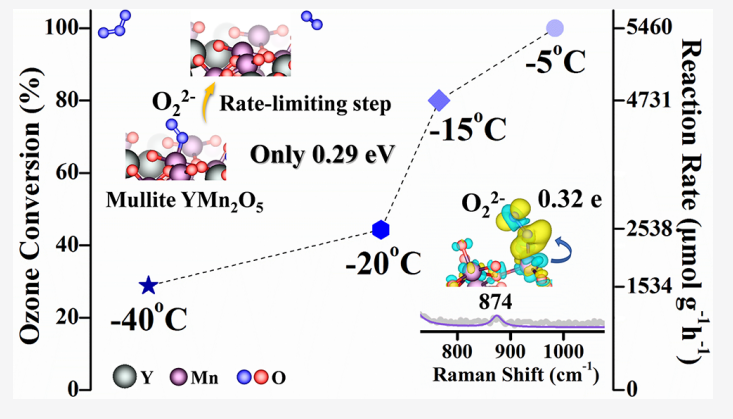
The results of O2-TPD (O2-temperature-programmed desorption) indicated that the active site was the Mn3+ site on the surface bound to single-coordinated oxygen. Combining in-situ Raman measurements and density functional theory calculations, we found that the potential barrier of the decomposition reaction of ozone on YMn2O5 is only 0.29 eV, following the ley-Rideal (E-R) mechanism and accompanied by the rate-limiting step of intermediate O2-desorption. The low barrier greatly reduces the accumulation of intermediate products and enables the rapid decomposition of O3 even at ultra-low temperatures. Fundamentally, the moderate Mn−O bond strength in low-symmetry ternary oxides is crucial for generating single-coordinated active substances on the surface, which are responsible for effective ozone degradation at low temperatures.
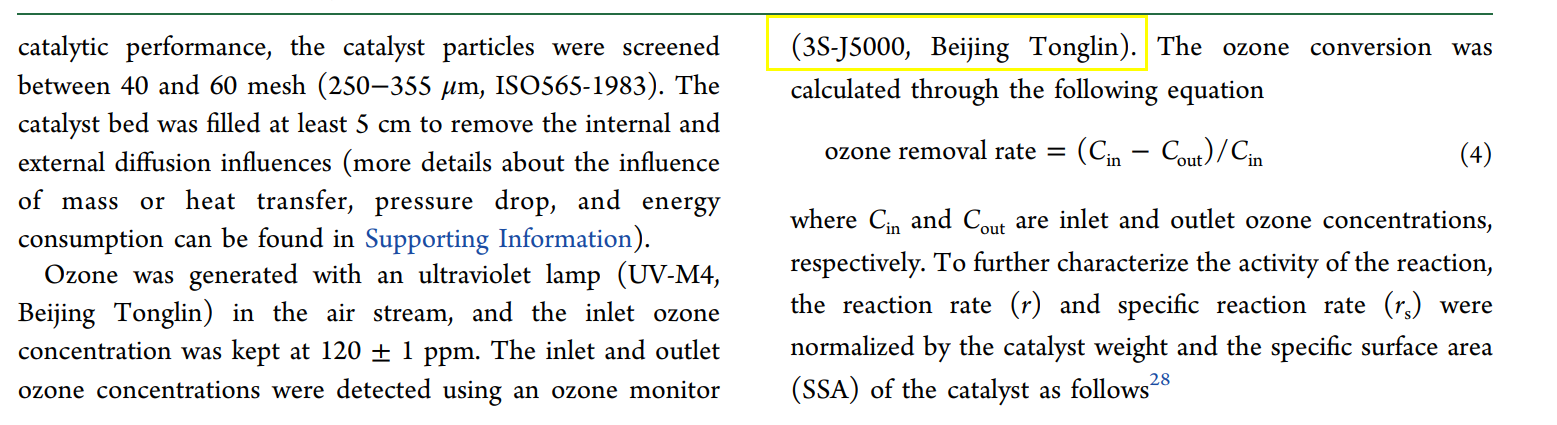
Source:Ozone Decomposition below Room Temperature Using Mn-based Mullite YMn2O5 | Environmental Science & Technology (acs.org)
https://pubs.acs.org/doi/10.1021/acs.est.1c08922
 Bridging Dissolved Organic Mat
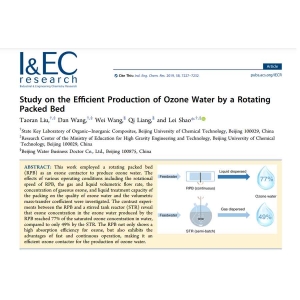 Study on the Efficient Product
 Green aromatic aldehydes produ
 Effects of advanced catalytic