
Fundamental Theory of Ultraviolet Spectroscopy Absorption
The core working principle of the UV ozone online analyzer is based on ultraviolet spectroscopy absorption, an advanced technique that utilizes the characteristic absorption properties of substances for specific wavelengths of ultraviolet light to perform quantitative analysis. The theoretical foundation of this method can be traced back to molecular spectroscopy studies in the early 20th century, and it has now become the internationally recognized gold standard for ozone detection.
Fundamental Theory of Ultraviolet Spectroscopy Absorption
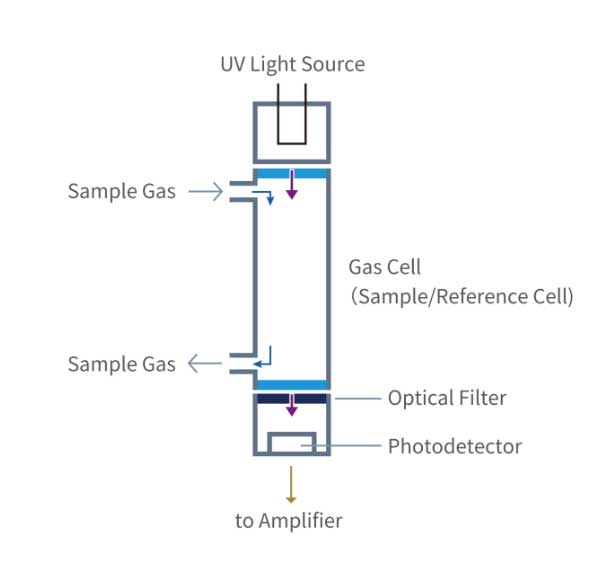
In the technical specifications of the U.S. Environmental Protection Agency (EPA), this method is established as the standard analytical method for ozone (EPA Method 49 CFR Part 53). In China's environmental monitoring field, it is designated as the standard method for determining ozone in ambient air (GB/T 1154348). The superiority of this method is primarily reflected in its high sensitivity, exceptional selectivity, and excellent repeatability, enabling it to meet the stringent requirements of various application scenarios, from ambient air monitoring to industrial process control.
The theoretical cornerstone of ultraviolet spectroscopy absorption is the Lambert-Beer Law, which precisely describes the absorption of light as it passes through a homogeneous medium. Its complete mathematical expression is:
I = I₀e^(-k⋅l⋅c)
Here, the physical quantities are clearly defined:
- I₀ represents the incident light intensity,
- I denotes the transmitted light intensity,
- l is the optical path length,
- c is the concentration of the absorbing substance,
- k is the specific absorption coefficient of the absorbing substance at a specific wavelength. This coefficient is a unique characteristic constant of the substance.
In practical engineering applications, the law is often converted into a form more convenient for calculation:
I/I₀ = e^(-a⋅c⋅L)
Here,
- a specifically refers to the absorption coefficient of ozone at the 254 nm wavelength,
- c is the ozone concentration to be measured,
- L is the carefully designed optical path length.
By precisely measuring the transmittance I/I₀ and combining it with a strictly calibrated absorption coefficient and accurately manufactured optical path length, the ozone concentration can be accurately calculated. This method achieves measurement accuracy at the parts per billion (ppb) level and exhibits excellent resistance to cross-interference, ensuring reliable measurement performance even in complex multi-component gas environments.
 Ozone and Indoor Air Quality:
 Comparing Ozone Measurement Te
How to Install a Dissolved Ozo
Comparing Ozone Measurement Te
How to Install a Dissolved Ozo
 Common Myths About Ozone Detec