
Ozone Monitor Maintenance Schedule: Daily, Monthly and Annual Checks
Ozone Monitor Maintenance Schedule: Daily, Monthly and Annual Checks
An ozone monitor is one of the few instruments on a plant floor whose reading decides whether people stay in a room. That makes its upkeep a question of validity rather than housekeeping. A number produced by an analyser whose sample filter has been blocked for two months is a number without a meaning, and the failure is quiet: there is no alarm for a partially clogged filter, no warning for a UV lamp that has lost a fifth of its output, and no notification that the span has moved four percent since the last check.
The schedule below is built around that asymmetry. It places the cheap checks where they catch the expensive failures early, and it produces a written trail so that a reading can still be defended months later.
Why Drift Is the Specification Maintenance Protects
Datasheets quote zero drift and span drift as a percentage per month or per year. Whatever the figure, drift is cumulative and unbounded unless something checks it. A zero that walks upward by a small amount each week looks like a slowly rising ozone concentration in the log, which is exactly the kind of trend an operator learns to explain away rather than investigate.
Maintenance exists to put a known reference in front of the sensor on a schedule, so that the difference between the reading and the truth is measured instead of assumed. Everything else in the schedule — filter changes, leak tests, lamp replacement — serves the same purpose indirectly, by removing the physical causes of an offset before they become large enough to hide inside a calibration adjustment.
Daily Checks: Ten Minutes That Catch Most Faults
Zero reading at the start of the shift
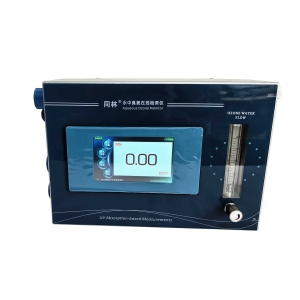
Put zero air through the analyser, either from a scrubber cartridge or from a cylinder, and confirm the display falls to the baseline stated in the manual. The analyser in the photograph above is sitting at 0.00, which is what a healthy optical bench reads on scrubbed air. A reading that will not fall, or that falls slowly and then creeps back, points to a contaminated optical cell, a leaking internal sample path, or a lamp that is losing intensity.
Sample flow and inlet condition
Read the rotameter or the flow status on screen and compare it with the value recorded at commissioning. A flow that has dropped by more than roughly a tenth of its setpoint usually means a loaded filter, a failing pump diaphragm or a kinked line. On ambient monitors, also look at the inlet: a rain cap knocked sideways, insect screening matted with dust, or a sample line that has collected condensate all change the reading without changing the instrument.
Alarm and fault indicators
Confirm that the instrument is not sitting in a fault or hold state, and that the alarm relays are still enabled after any maintenance work the day before. A relay left in manual override is a safety gap that no calibration will reveal.
Monthly Checks: The Sampling System Is Where Readings Fail
Leak test on the sample line
Most ozone monitors draw their sample under slight negative pressure. That is convenient, and it is also the reason a small leak matters more than it looks: air pulled in through a cracked fitting dilutes the sample before it reaches the cell, so the instrument reports a concentration lower than the true one and does so consistently. Cap the inlet, pull vacuum, and watch whether the pressure holds. This single test explains a large share of the cases where an ozone monitor reads low while the generator and the process look normal.
Zero and span check, as distinct from calibration
A span check is a comparison, not an adjustment. Pass a known reference gas or use a built-in ozone generator with a reference photometer, record the reading without touching the calibration, and decide afterwards whether an adjustment is justified. Keeping the two activities separate preserves the diagnostic value of the check: if every span check ends in an adjustment, drift can no longer be tracked.
Filter, trap and tubing inspection
Replace particulate filters on condition or on the manufacturer's interval, whichever comes first. Empty water traps before they fill, and inspect tubing for clouding, hardening or ozone attack on elastomer parts. Tubing that has absorbed ozone or degraded in UV light can outgas for weeks and produce a low-level background that the zero check will read as contamination.
Quarterly and Annual Work
Full calibration against a traceable reference
Recalibration belongs on a fixed interval, set by the application and by the drift observed in the span checks rather than by a calendar alone. Workplace monitoring that supports an exposure record may warrant a quarterly interval; a process monitor with stable readings and a recorded drift history can run longer. Where the instrument is used to demonstrate compliance with an occupational limit — for ozone in the United States the permissible exposure limit is 0.1 ppm as an eight-hour time-weighted average, listed in OSHA's air contaminants table, 29 CFR 1910.1000 Table Z-1 — the calibration record is part of the evidence, not an optional extra.
Consumables with a defined life
UV lamps age, electrochemical cells deplete, pumps wear and batteries lose capacity. None of these fail on a convenient date. Track operating hours rather than wall time where the instrument provides them, and replace at the point the manufacturer specifies instead of waiting for the reading to collapse. A lamp replaced at end of life costs a lamp; a lamp replaced after a quarter of inaccurate data costs the credibility of the whole monitoring programme.
Enclosure, setpoints and relays
Once a year, open the enclosure, clear dust from the intake path, check terminal tightness and verify that alarm setpoints still match the values in the site procedure. Setpoint drift after a controller replacement or a firmware update is a common and invisible failure.
The Log Is Part of the Instrument
A maintenance schedule without records is a habit, not a system. The log for each instrument should carry, at minimum:
- Date, time and the name of the person who performed the check
- Instrument identifier and location, matching the site register
- Reading before any adjustment, and the reference value used
- Action taken — nothing, cleaned, replaced, recalibrated — and the result
- Reference source and its own calibration due date
- Next due date for each item on the schedule
This is the record that answers the two questions asked after any incident: what did the instrument read, and how do you know the instrument was telling the truth at the time.
A Schedule at a Glance
| Interval | Task | Typical failure it catches |
|---|---|---|
| Each shift | Zero check, flow check, fault status, relay state | Cell contamination, blocked filter, pump wear |
| Weekly | Inlet and sample line visual inspection, condensate removal | Water ingress, insect screening blockage |
| Monthly | Leak test, span check, filter and trap service | Dilution by in-leakage, span drift |
| Quarterly | Full calibration to a traceable reference, records review | Accumulated zero and span offset |
| Annually | Lamp or cell replacement, pump service, setpoint and relay verification | End-of-life components, alarm misconfiguration |
When the Fault Is Not Maintenance
A monitor that has been serviced correctly can still report the wrong thing. A sensor mounted in a dead air pocket, too close to a diffuser, or downstream of a generator cabinet door reads a concentration that has little to do with the room; placement rules are set out in our guide to where to install an ozone monitor. A monitor whose range is mismatched to the task saturates or loses resolution, and the way range, resolution, accuracy and response time interact is explained in our guide to ozone monitor specifications. If a reading has fallen without any change to the process, the diagnostic order matters: reasons an ozone detector reads low separates instrument faults from sampling faults, while bump test versus calibration clarifies which of the two checks proves what.
For instruments used to protect people, the health basis for treating indoor ozone as a controlled contaminant is set out in the US Environmental Protection Agency's guidance on ozone generators sold as air cleaners, and the reference methods and standards behind calibration practice are catalogued on our citations and reference standards page.
Start With the Interval You Can Keep
A monthly leak test that is actually performed is worth more than a quarterly audit that is skipped. Write the schedule around the staff and the shifts that exist, put the zero check where it fits naturally into a shift handover, and add items as the log shows where the readings are weakest. Gas-phase instruments for workplace and process monitoring are described under gas ozone monitors, and the dissolved-side equivalent — where membrane fouling and flow rate dominate maintenance — under ozone in water monitoring.
 Confined Space Entry and Ozone
 How Do You Prepare Zero Air an
Can You Install an Ozone Monit
 When Should You Replace the UV