
Why Does My Ozone Monitor Drift? Zero Drift vs Span Drift
Why Does My Ozone Monitor Drift? Zero Drift vs Span Drift
A monitor that reads 0.03 ppm in clean air and comes up 6 percent short on the same span gas it passed three months ago has not failed. It has drifted — and the direction of that drift changes what you should do about it. One kind shifts every reading by a fixed amount. The other scales every reading by a percentage. Confuse the two and you will recalibrate a sensor that needs a new lamp, or replace parts on an instrument that needed a zero correction.
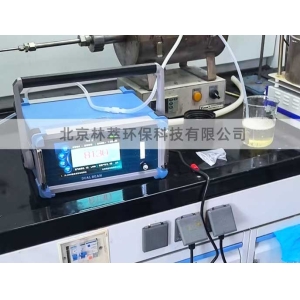
A bench check on a UV absorption ozone analyzer. The zero and span readings are separate pieces of information that drift for different reasons.
What drift actually means
Every ozone reading rests on two numbers. The first is what the instrument shows when no ozone is present — the zero, or baseline. The second is how far the signal moves for a given amount of ozone — the sensitivity, or span. Drift means one of those two numbers has moved since the last calibration, and the reading no longer traces the true concentration.
Zero drift is a constant offset. If your baseline has crept up by 0.02 ppm, then every reading is 0.02 ppm high. At a workplace limit of 0.1 ppm that is a 20 percent error, which matters a great deal. At 5 ppm in a generator outlet it is 0.4 percent, which is noise.
Span drift is multiplicative. If sensitivity has fallen 5 percent, every reading is 5 percent low — small concentrations and large ones alike. A 0.08 ppm reading is really 0.084 ppm, and a 4.00 ppm reading is really 4.21 ppm.
This is why "the monitor is reading wrong" is an incomplete diagnosis. The size of the error at the concentration you care about depends entirely on which of the two has moved.
One test that separates them
You do not need specialised equipment to tell zero drift from span drift. You need two points: zero air, and one known ozone concentration.
Run the zero check first. If the instrument will not settle near zero, you have a baseline problem, and there is no point checking span until it is resolved — a baseline error contaminates the span result.
Then run the span check on a known concentration. Compare the error at that level with the error you measured at zero. If the error is roughly the same at both points, the problem is additive: zero drift. If the error grows in proportion to concentration, the problem is multiplicative: span drift. If both are present, you have both, and they need to be handled in that order.
| Symptoms | Zero drift (baseline) | Span drift (sensitivity) |
|---|---|---|
| Error at zero air | Reads above or below zero | Reads close to zero |
| Error on span gas | Same fixed offset as at zero | Offset grows with concentration |
| Typical causes | Dirty optical cell, exhausted scrubber, electronic offset, pressure change | Lamp ageing, sensor electrolyte loss, electrode fouling |
| Corrective action | Clean, replace scrubber, re-zero | Re-span; if it will not hold, replace the consumable |
| Risk if ignored | Large relative error at low concentrations | Uniform percentage error at all concentrations |
Where UV photometric monitors drift from
A large share of industrial ozone monitoring uses the absorption of 254 nm ultraviolet light, because ozone absorbs strongly at that wavelength and almost nothing else in clean air does. In the United States this photometric principle is the reference method for ambient ozone under 40 CFR Part 50, Appendix D. Its drift sources are mostly optical and mechanical.
The lamp ages
A low-pressure mercury lamp loses output over thousands of hours. Good instruments measure lamp intensity continuously and divide it out, which extends usable life considerably — but the correction has limits. When the lamp has decayed far enough, the signal-to-noise ratio at low concentrations degrades and the instrument starts to look unstable before it looks inaccurate.
The cell windows get dirty
Dust, humidity films and polymer haze on the optical windows attenuate the beam. Because the instrument cannot tell attenuation by dirt from attenuation by ozone, contamination generally reads as a positive offset — a false baseline. In dirty plant rooms this is a frequent cause of zero drift.
The scrubber stops scrubbing
Photometric instruments establish zero by passing sample air through a catalytic or chemical scrubber that removes ozone, then comparing that reading with the unscrubbed reading. When the scrubber is exhausted, ozone slips through, the "zero" reference is no longer zero, and the computed concentration reads low — often dramatically. A scrubber that has been in service for a year in a humid, high-ozone location is a prime suspect.
Flow, pressure and temperature move
The measurement depends on a fixed optical path and a stable sample flow. A blocked filter, a tired pump or a change in back pressure alters how much ozone sits in the cell. Barometric pressure shifts change the number of molecules in the path, which is why a monitor moved to a pressurised room may need re-zeroing even though nothing is wrong with it.
Where electrochemical sensors drift from
Electrochemical ozone sensors are consumables by design. The electrolyte is gradually consumed, the electrodes passivate, and sensitivity declines steadily rather than sitting flat and then failing. A slow downward slope over months is normal behaviour, not a fault — but the slope has to be tracked, or the decline will be discovered only when a reading no longer makes sense.
Two things accelerate it. Extreme dryness pulls water out of the electrolyte; sustained high humidity can flood the sensor. Both show up as erratic or sluggish response long before they show up as a clean span error. If a sensor needs re-spanning more often than every few weeks, replacement is usually cheaper than repeated calibration.
How much drift is too much
A fixed number copied from a datasheet is less useful than a drift rate measured on your own instrument. The practical question is whether the monitor holds its zero within the resolution you rely on, and its span within the tolerance your decisions require, between calibrations.
Work backwards from the decision. If 0.1 ppm triggers action and you can tolerate being 5 percent wrong, then 5 percent span error is your ceiling. If that ceiling arrives in six weeks, calibrating quarterly is not enough — shorten the interval or fix what is causing the loss. Recording zero and span at every check turns this into a trend line. The calibration interval guidance covers how to set the schedule; the drift record tells you whether the schedule is right.
When it is not drift at all
Before opening the instrument, rule out the sampling system. A small leak on the suction side dilutes the sample with room air and reads as a low span. Tubing that adsorbs or reacts with ozone — some elastomers do — removes ozone before it reaches the cell, with the same effect. Condensation in a cold line dissolves ozone out of the gas stream. All three look exactly like span drift and none of them will be fixed by recalibration.
Placement matters here too. A monitor mounted where the sample line runs through a hot ceiling void, or where the intake sits in the wake of a door, will produce readings that wander for reasons that have nothing to do with the sensor. The installation placement rules are worth re-reading whenever drift appears suddenly rather than gradually.
A short routine that keeps drift visible
Five habits, none of them time-consuming, will keep a drifting instrument from becoming a surprise:
1. Log the zero value, not just pass or fail. A baseline that has moved 0.005 ppm in a month is telling you something a month before it fails a check.
2. Log the span result as a percentage. Trend the number; a 2 percent loss and a 2 percent loss every quarter are very different problems.
3. Change the scrubber on a schedule, not on failure. Scrubber exhaustion produces quiet, plausible, wrong readings — the worst failure mode in monitoring.
4. Clean the optics when the zero moves, not annually. Cleaning is cheap; a contaminated cell that has been trusted for half a year is expensive.
5. Replace electrochemical sensors on slope, not on death. When the required calibration frequency doubles, the sensor is already telling you it is finished.
If you are choosing an instrument and want to know which drift behaviour to expect, the comparison of monitoring approaches across applications and the range of dissolved and gas-phase monitors put the trade-offs side by side. Measurement principles and their limits are also collected in the technical references section.
Drift is not a defect. It is the instrument reporting that its reference has moved. The job is to hear that early, and to know which reference moved — because a zero error and a span error call for different responses, and only one is fixed by turning a screw. Ambient monitoring background is covered by the US EPA ozone pollution programme.
 Confined Space Entry and Ozone
 How Do You Prepare Zero Air an
Can You Install an Ozone Monit
When Should You Replace the UV